
When Li Zhan first arrived in Sri Lanka ten years ago, she did not come with a plan to settle. She came as a volunteer, staying in a small coastal village, helping with sea turtle conservation and spending time at a children’s home.
Today, many Sri Lankans know her simply as “Lisa,” a foreign woman who lives, works and raises her child on the island — not as a visitor, but as a neighbour.
She resists framing her life around “cross-cultural love”. Instead, she describes herself in simpler terms: “someone who just keeps living.” Over the past decade, Lisa has lived through Sri Lanka’s most turbulent recent years — enduring prolonged pandemic separation, navigating fuel and power shortages during the economic crisis, cooking over firewood in rural areas, and gazing at unpolluted night skies along the southern coast.
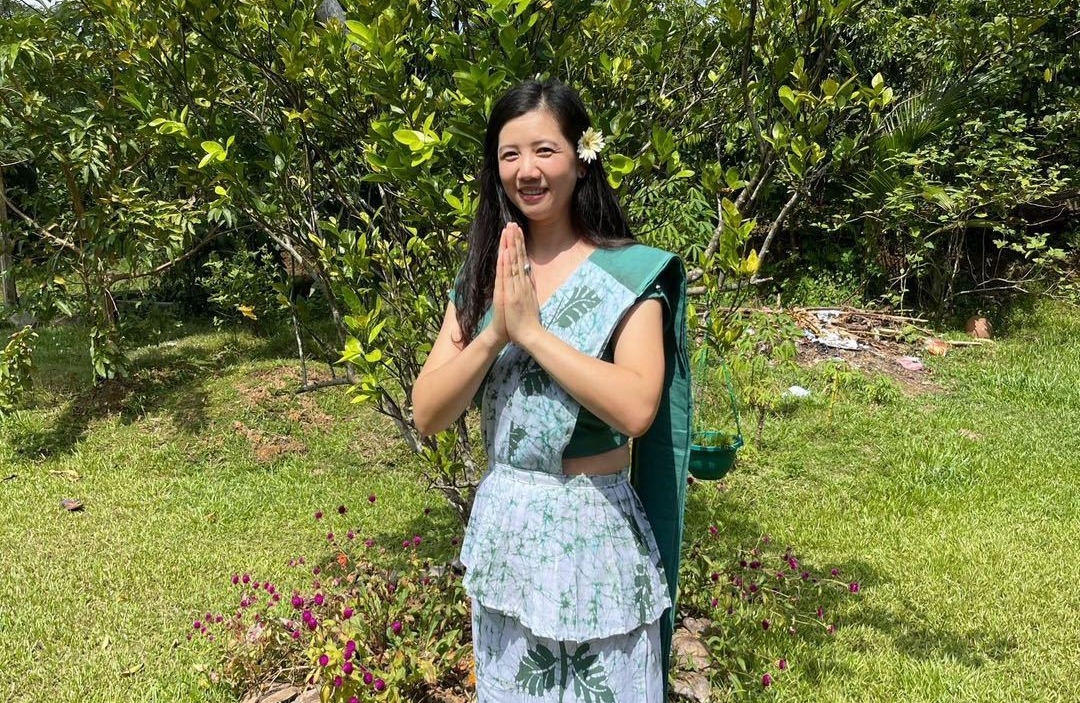
Photo caption: Lisa wearing a traditional Kandyan sari
A volunteer trip that disrupted a life built on efficiency
Ten years ago, Lisa was deeply embedded in China’s export sector in eastern Zhejiang province, moving between orders, quotations and trade fairs. Time was measured in output and margins, and daily life revolved around speed and efficiency.
Her first trip to Sri Lanka was not intended as migration. It began as a short volunteer programme focused on sea turtle conservation and work with a children’s home. Despite not being a university student — a typical requirement — she applied and was accepted.
A group initially planned for more than a dozen volunteers eventually consisted of just two participants: Li and another woman from Ningbo.
For two weeks, they lived in a coastal village in southern Sri Lanka. Days were spent reading with children, assisting newly hatched turtles towards the sea, and walking along the shoreline at dusk.
There were no performance targets or income-related questions. Local residents greeted them not with inquiries about earnings, but with small talk about meals and sunsets.
“That sense of ease — life not being driven by utility — stayed with me,” Lisa said.
It was also during this programme that she met her future husband, the Sri Lankan coordinator of the volunteer project. She is careful not to describe the relationship as destiny-driven. What resonated, she said, was a different hierarchy of life: people mattered more than productivity.
Photo caption: Lisa participating in a volunteer programme
Separation, uncertainty and a decision shaped by connection
The most severe test came during the COVID-19 pandemic.
Lisa and her husband were separated for 22 months and eight days due to border closures and suspended flights. She remained in China, managing the decline of her foreign trade business, while her husband stayed in Sri Lanka navigating pandemic disruptions.
“We met during the pandemic,” Lisa recalled. “That was the first time I actively added strangers on social media — just to understand what was really happening there.”
Naturally introverted, she found herself messaging anyone connected to Sri Lanka, asking about medical supplies and public health conditions. She said it was not romance alone that sustained her, but the accumulation of small, steady connections.
Her husband marked each day of separation by hand, counting 672 days in total. “Today, still waiting for you,” he wrote daily.
When the worst phase of the pandemic eased, Lisa made a decision that many around her considered high-risk: she closed her remaining business in China and moved to Sri Lanka with her daughter.
“My husband told me, ‘Where you are, that’s where home is,’” she said. “That gave me certainty.”
Living through crisis, redefining abundance
Shortly after her arrival, Sri Lanka entered its most severe economic crisis in decades. Power cuts and fuel shortages became routine, particularly in urban areas.
Lisa relocated from Colombo to a rural house. When electricity failed, cooking shifted from induction stoves to firewood.
“It was my daughter’s first time seeing a real wood-fired stove,” Li said. “She thought the food tasted better.”
Rather than framing scarcity as deprivation, Lisa sought to normalise adaptation. Without electricity, they sat outdoors watching the stars. “If there were city lights, you wouldn’t see the Milky Way like this,” she told her daughter.
She later bought two sheep, which her daughter helped care for — an image that surprised friends until videos confirmed it.
Mornings began with birdsong; days involved gardening and tending animals; evenings ended by the sea. “It was a very simple life,” Lisa said. “But it felt complete.”
Business built on patience
Today, Lisa divides her time between a Chinese restaurant in central Colombo and a small-scale coloured gemstone business.
Her restaurant, Jing Season Chinese Restaurant, is located in the old flower road. The space is understated, featuring private dining rooms for business gatherings upstairs and more relaxed communal areas downstairs, including recreational facilities uncommon in formal dining venues.
The kitchen is led by a Sichuan-trained chef who regularly experiments with new dishes. “If it’s not right, we redo it,” Lisa said.
Rather than aggressive marketing, Lisa’s online presence focuses on daily operations and staff interactions. “Customers tell us they trust the place because it feels real,” she said.
Her business philosophy prioritises sustainability over rapid expansion. She spent months visiting local markets to design menus suited to local expectations, adjusting flavours through direct feedback from Sri Lankan diners.
Gemstones, meanwhile, remain a personal passion. Introduced to gemology during the pandemic, Li became fascinated by natural inclusions visible under magnification.
“People chase perfection,” she said. “But it’s the imperfections that make each stone unique.”
She avoids pressure selling and often advises hesitant buyers to wait. One customer later returned to commission a wedding ring, telling her: “I trust you.”
Photo caption: Exploring gemstone mining areas in Sri Lanka.
Returning to where it began
Beyond business, Lisa hopes to revive small-scale volunteer travel programmes similar to the one that first brought her to Sri Lanka. Her husband, an experienced guide, would co-lead the initiative.
The plan includes adult volunteer trips focused on turtle conservation and programmes for children during school holidays, offering exchanges with rural schools and environmental education.
“The goal is simple,” Lisa said. “To help people understand Sri Lanka more honestly, and to let children connect with nature.”
Asked how she ranks life priorities, her answer is unambiguous: family first, friends second, work third. She rejects labels such as “multi-hyphenate woman” or “successful transformation.”
“I’m just someone trying to live seriously within uncertainty,” she said.
After a decade marked by separation, crisis and quiet beauty, Li says Sri Lanka’s slower rhythms have given her something rare: a sense of inner calm.
Photo caption: Kai leading children on a mangrove exploration.