
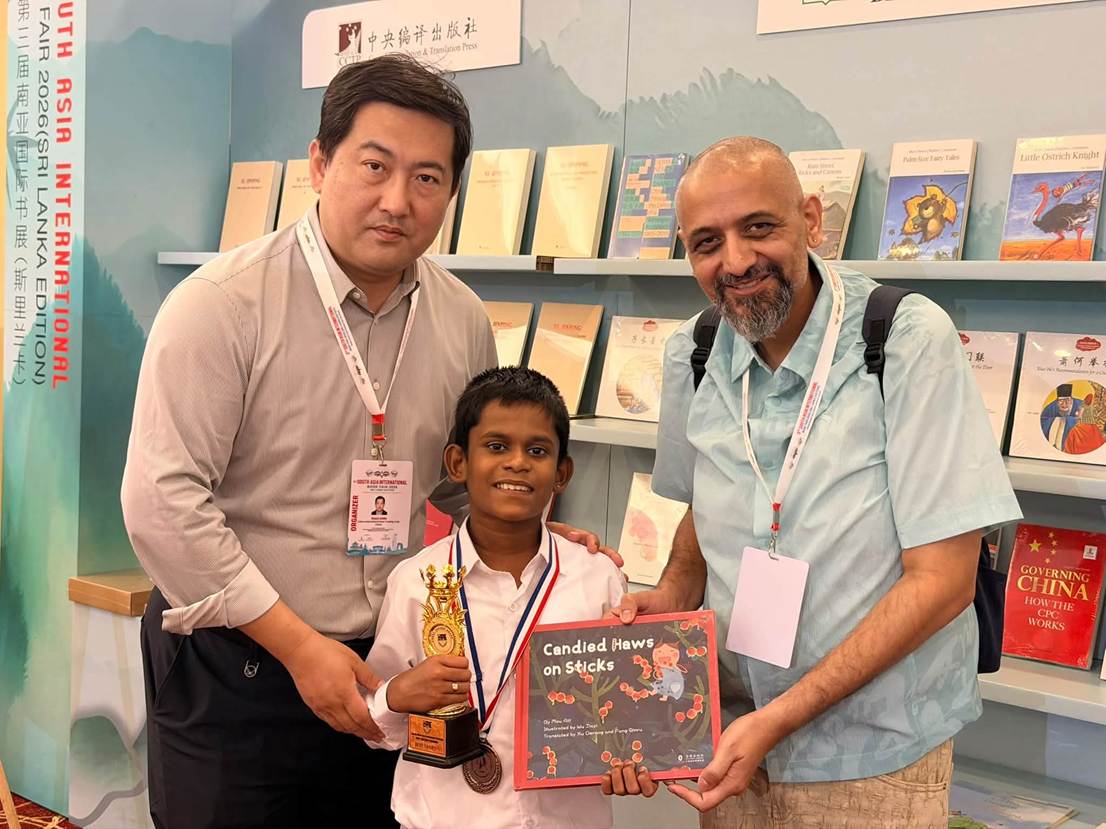
At the Bandaranaike Memorial International Conference Hall in Colombo, something quietly unusual was taking place.
Readers from Sri Lanka wandered between rows of books alongside publishers, writers, editors and rights managers from China, Nepal, India, Pakistan, Kyrgyzstan and beyond. At the stands, people stopped to browse, exchange recommendations and talk about stories that might one day travel across languages and borders.
Among them was Kiran Gautam, president of Nepal’s Contemporary Media and Research Centre and Contemporary Publications, a recipient of the Youth Achievement Award under the China Book Special Contribution Award. As one of the key initiators of the South Asia International Book Fair, Gautam has spent years working across Nepal, China and South Asia to encourage publishing, translation and cultural exchange.
For five days in Colombo, books became the common language.
A Book Fair with a Wider Horizon
The third South Asia International Book Fair was held at the Bandaranaike Memorial International Conference Hall, alongside the Colombo International Book Fair. The event brought together publishing and cultural institutions from China, Sri Lanka, Nepal, India, Pakistan, Bangladesh, Malaysia, the Philippines and Kyrgyzstan.
The Chinese section drew particular attention.
A cultural exhibition themed around the voyages of Zheng He traced centuries of maritime connections across the Indian Ocean. Visitors stopped to take photographs, try on traditional Chinese clothing and sample Pu’er tea and Yunnan flower cakes.
For many, these small encounters were perhaps as memorable as the books themselves.
Chinese Ambassador to Sri Lanka Wei Huaxiang and Nepal’s Chargé d’Affaires a.i. Vijay Kumar Raut also visited the fair, browsing the stands and signing copies of Ceylonese, a magazine dedicated to cultural exchange between Sri Lanka and China.
It was a lively scene, but also an intimate one: people discovering unfamiliar books, asking questions, sharing recommendations and simply enjoying the pleasure of being surrounded by stories.
And that may be the most interesting thing about a book fair.
It creates a space where cultural exchange does not have to begin with grand statements. Sometimes, it begins with picking up a book.
Beyond the Book Stall
The fair was organised with a strong emphasis on publishing cooperation, bringing together the China International Book Trading Corporation, the Contemporary Media and Research Centre of Nepal and the Sri Lanka Booksellers Association, among other partners.
Copyright discussions, book launches, author conversations and recommendation sessions ran throughout the five-day programme.
Chinese publishing representatives also visited local libraries and bookshops in Sri Lanka, looking beyond the exhibition hall to understand how books actually reach readers in the local market.
For publishers, these conversations are practical ones.
Which books are likely to resonate with readers in another country? How can translation be made more accessible? Which distribution channels work best? Could publishers from different countries work together on a single title?
These questions may sound technical, but behind them lies something very human: the desire to make a story understandable to someone who grew up somewhere else.
Kiran Gautam and a Long-held Idea
For Gautam, the book fair is the continuation of a much longer journey.
He grew up in a family connected with newspapers and publishing, surrounded from an early age by ink, paper and words. He began writing as a teenager and gradually came to understand the unusual ability of books to travel where people themselves cannot always go.
The idea of creating a book fair connecting South Asian countries and opening a window to China was also rooted in a family aspiration.
Turning that idea into reality, however, was far from simple.
The pandemic interrupted the early preparations. Funding, international coordination, differences in working rhythms and the practical challenges of publishing across multiple markets all added layers of difficulty.
Yet Gautam kept going.
Across South Asia, literary festivals and book fairs are already part of cultural life. What he wanted was to give these encounters a longer life — to turn conversations at a book stall into translation projects, copyright agreements, new editions and relationships that continue after the exhibition closes.
That is why the South Asia International Book Fair feels less like a one-off celebration and more like a work in progress.
When a Story Travels
Some of the most interesting moments at the fair came from books that had already begun their own journeys.
A Nepali edition of A History of the Development of Artistic Exchange in Tibet, published by Zhejiang University Press, was launched during the event, bringing Chinese scholarship and research to readers in South Asia.
Another project offered a different kind of example.
A book about the Sacred Tooth Relic of Sri Lanka, written by Dinesh Kulatunga, former president of the Sri Lanka Booksellers Association, carries the history, beliefs and cultural memory surrounding one of Sri Lanka’s most important Buddhist sites.
The project involved cooperation across three countries: a Sri Lankan author and original work, a Nepali publishing partner, and Chinese assistance with translation and editorial coordination.
It is a relatively small publishing project. But that is precisely what makes it interesting.
Cultural exchange does not always happen through large institutions or major productions. Sometimes it begins with one author, one publisher and one translator deciding that a story deserves to be read somewhere else.
What Kind of Story Travels Best?
During a discussion at the fair, I asked Gautam a simple question from a market perspective:
When books move between China and South Asia, what kinds of stories have the best chance of crossing cultural boundaries while also reaching readers?
His answer was refreshingly practical: children’s books.
Compared with highly specialised academic works or lengthy literary fiction, children’s books often have a simpler language, a more accessible structure and fewer barriers to translation.
More importantly, many children’s stories speak to experiences that are familiar across cultures — friendship, family, curiosity, courage, kindness and growing up.
A story does not need to explain an entire civilisation to create a connection.
Sometimes, a child simply needs to recognise another child’s world.
That gives children’s publishing a quiet but powerful role in cultural exchange. Chinese children’s books entering South Asian homes and schools can offer young readers a glimpse into another society. Likewise, illustrated stories from South Asia can introduce Chinese children to landscapes, traditions and characters from across the Indian Ocean.
The influence may be gradual, but it can last for years.
Rethinking the Bookshop
The conversations at the fair also went beyond translation and international publishing.
Aydai Maksatbekova, founder of IQ Bookstore in Kyrgyzstan, shared her experience of developing new ways for a bookshop to operate.
Selling books is no longer necessarily the whole business.
Community events, cultural programmes, creative products, partnerships and services for organisations can all become part of a modern bookstore’s life.
For publishers and booksellers facing rising paper, printing, logistics and inventory costs, such ideas offer a reminder that a bookstore can be more than a place where books are sold.
It can also be a meeting place.
A classroom.
A cultural space.
Or simply somewhere people like to spend an afternoon.
The Small Things Matter
The publishing industry across South Asia faces real economic and practical pressures. But the conversations in Colombo suggested that cultural curiosity has not disappeared.
If anything, difficult times can make meaningful connections feel more valuable.
A book cannot solve every problem facing an industry. One book fair cannot transform the publishing landscape of an entire region.
But it can create something smaller and perhaps more durable: a network of people who know one another, a translator who discovers a new author, a publisher who finds a new market, a reader who encounters a story for the first time.
Change often begins this way.
Not with a grand declaration, but with a conversation.
Not with an entire library, but with one book.
The Stories We Carry
International relations are often discussed through economics, institutions and borders. Books offer another way of seeing the world — one that is quieter and much closer to everyday life.
A novel can reveal how a family celebrates a festival. A children’s book can introduce a landscape that a reader has never visited. A memoir can make an unfamiliar place feel unexpectedly intimate.
Stories allow us to meet people not as representatives of a country, but simply as people: with their families, memories, beliefs, humour, hopes and everyday worries.
Perhaps that is the most enduring promise of a book fair.
To put a book in someone’s hands and say, in the simplest possible way:
Here is a story from my part of the world. I hope you will read it.