
14 September 2025
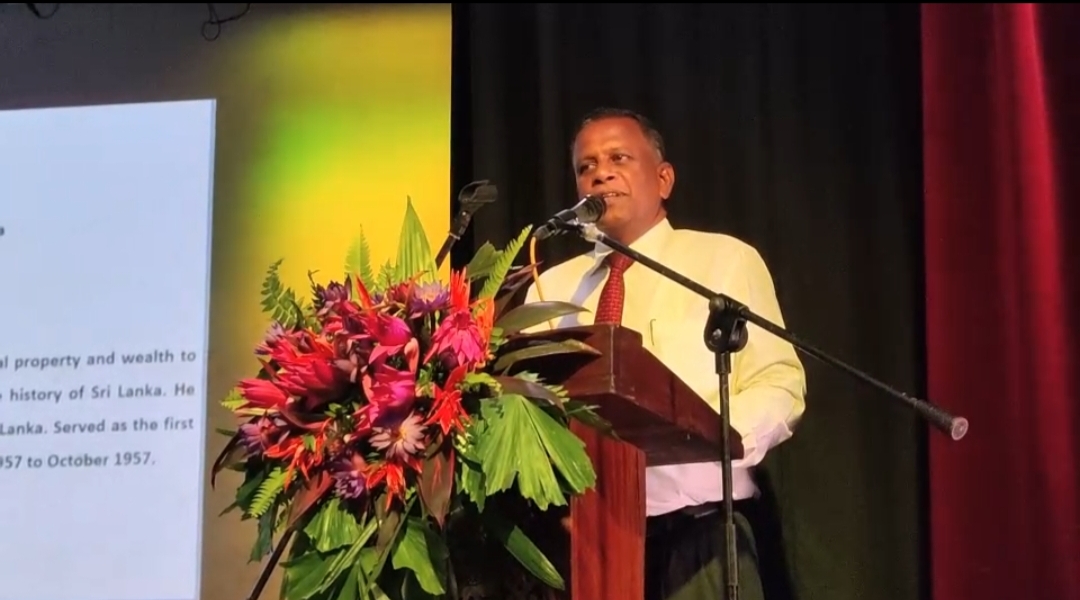
In a quiet lecture hall filled with sunlight, Vipula Jayampathi, Vice President of the Sri Lanka–China Society, shared his personal encounters with China to answer a question from students: How did China rise?
The event, part of the “Me and China” lecture series hosted by the China Cultural Center in Sri Lanka and co-organized by the Sri Lanka–China Society, took place at Sri Palee College with more than 170 students and teachers in attendance.
Jayampathi began his talk by showing a photo of “Faxian Village” — a small community in Sri Lanka named after the Chinese monk Faxian, who visited the island over 1,500 years ago. “Faxian not only brought a Chinese perspective,” he told the audience, “but also opened the first bridge of understanding between our two civilizations.”
From Family Memories to National Ties
Jayampathi recalled that his father, a leftist intellectual, often read Chinese and Russian journals when he was young. “Through those pages, I glimpsed an awakening East,” he said. For him, the most moving chapters in China–Sri Lanka friendship emerged “in times of hardship.”
In the 1950s, as Sri Lanka (then Ceylon) faced a severe food shortage and China was under Western trade embargo, the two nations struck a historic agreement — exchanging Chinese rice for Sri Lankan rubber. Known as the “Rice-Rubber Pact,” it became the first trade deal between China and a non-socialist country.
“I remember my mother telling me that Chinese rice helped many Sri Lankan families survive that crisis,” Jayampathi said. “Later, I discovered that China itself faced food scarcity but still fulfilled its commitment — a gesture of true friendship.”
Sri Palee College itself carries the legacy of that era. Founded by statesman Wilmot A. Perera, Sri Lanka’s first ambassador to China after the establishment of diplomatic ties in 1957, the school has long served as a symbol of cultural exchange between the two countries.
Four Journeys, One Evolving Impression
Jayampathi has visited China four times since 2015 — to Guangzhou, Beijing, Shanxi, Hangzhou, and Kunming — often as part of cultural exchange delegations. His slideshow featured temples, bridges, markets, and city skylines — each photo accompanied by an observation.
During a 2017 trip with Sri Lankan photographers, he explored both urban and rural China. “What we captured was not contrast, but coexistence,” he said. “Tradition and modernity are not in conflict — they complement each other.”
From Shanxi’s ancient temples to Hangzhou’s canal districts, Jayampathi saw how cultural heritage and tourism were being integrated into sustainable local economies. “Sri Lanka can learn from this balance — preserving cultural roots while embracing modernization,” he added.
Lessons from Kunming
Among all his visits, Kunming left the deepest impression. “It’s a classroom of greenery and flowers,” he said, describing how the city transformed floriculture into a thriving industry. He noted two practices relevant to Sri Lanka: aligning industries with local climate and soil conditions, and organizing small farmers through training and cooperative models.
He was also struck by Yunnan’s “ethnic harmony in daily life.” “Fifty-five ethnic groups live and work together through shared festivals, performances, and industries,” he said. “It convinced me that Sri Lanka can pursue cultural coexistence in its own way — by learning, not copying.”
“The Silk Road Has Never Ended”
In 2024, Jayampathi attended the 70th anniversary of the Chinese People’s Association for Friendship with Foreign Countries at the Great Hall of the People in Beijing. “When President Xi Jinping spoke of ‘One planet, one destiny,’ I felt the world shrink — in a good way,” he recalled.
To him, China’s rise is not only about economic growth but also about “the synthesis of social order, ethnic inclusion, and global responsibility.” He highlighted China’s poverty alleviation as an example of systemic determination: “Eradicating poverty for over a billion people is not luck — it’s institutional strength.”
Concluding his talk, he told the students, “When China grows, Sri Lanka can grow with it. The Silk Road never ended — it continues through each of our steps.”
The “Me and China” lecture series has become a key platform for cultural dialogue between the two nations. Sri Palee College, founded in 1934 by educator and politician Wilmot A. Perera, integrates Chinese language and culture into its curriculum. Before and after the lecture, students performed Chinese songs, dances, and martial arts — a fitting celebration of a friendship that spans centuries.