
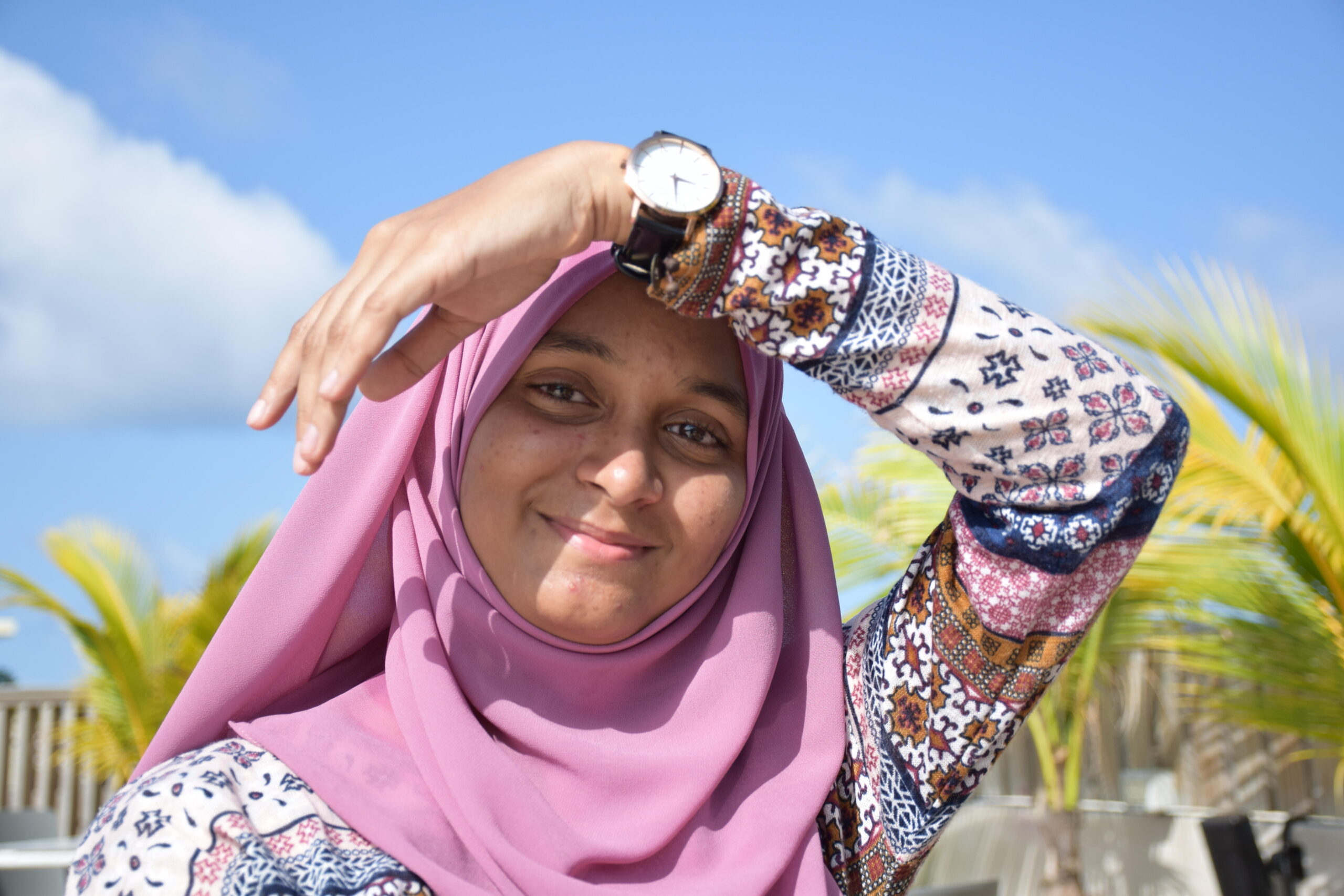
Gentle trade winds move through the coconut palms of Hanimadhoo, an island in the northern Maldives. Along its sandy shores, generations of islanders have lived with the rhythm of the sea and the shade of the trees. Coconut palms have long been part of that everyday landscape—offering food and materials, framing village life and helping protect the delicate edges where land meets ocean.
One morning this week, a small ceremony unfolded beneath the palms.
Ahmed Shiyam, the Maldives’ Minister of Fisheries, Agriculture and Marine Resources, and Kong Xianhua, China’s Ambassador to the Maldives, placed a modest green release device onto the trunk of a coconut tree affected by a tiny but destructive pest.
Inside were the pupae of two even smaller creatures: Tetrastichus brontispae Ferrière and Asecodes hispinarum Boucek, two species of parasitoids.
When they emerge, these insects will begin an invisible but carefully designed task. They seek out the coconut hispine beetle (Brontispa longissima), a pest that feeds on the tender leaves of coconut palms and can cause serious damage when populations grow unchecked. The parasitoids offer a natural form of biological control—a method refined through years of research and field practice in Hainan, China’s tropical island province.
For Hanimadhoo, it is a reminder that some of nature’s most important defenders are almost too small to notice.
An island tree under pressure
To visitors, the Maldives is often imagined through its turquoise lagoons, white beaches and overwater villas. But beyond the postcard image lies a landscape shaped by fishing communities, small-scale agriculture and close relationships with the natural world.
Across the islands, coconut palms are more than scenery. They are part of the ecological fabric of the atolls and a familiar presence in daily life. When the coconut hispine beetle attacks young leaves, entire groves can gradually lose their vigour.
For low-lying islands, healthy vegetation matters. Trees and coastal plants help stabilise fragile shorelines, while coconut groves also support local households in ways both practical and cultural.
The challenge is therefore not simply about saving a tree. It is about protecting a landscape that has long been woven into island life.
A solution travels across the sea
The biological-control programme now taking root in the Maldives draws on research conducted thousands of kilometres away in Hainan.
Wang Shuchang, Director of the Environment and Plant Protection Institute under the Chinese Academy of Tropical Agricultural Sciences, says the two island regions share some ecological similarities—and, importantly, a common challenge in managing the coconut hispine beetle.
Hainan experienced a major outbreak in the late 2000s, prompting researchers to test different approaches to controlling the pest. Over time, biological methods using specialised parasitic parasitoids proved particularly promising. Researchers developed breeding and release systems designed to work with natural ecological processes rather than relying solely on chemical treatments.
After years of monitoring and field application, the approach became an established part of coconut-palm pest management in Hainan.
When similar problems emerged in the Maldives, the experience offered a useful starting point for cooperation.
But transferring a solution from one island to another is never as simple as moving a piece of equipment. Climate, vegetation and local ecological conditions all matter.
That is why the project has focused on building local capacity. A parasitoid-breeding facility in Hanimadhoo, commissioned in 2026, will allow Maldivian technicians to rear the beneficial insects using locally collected hosts. The aim is to create a system adapted to the conditions of the islands themselves.
“Supplies arrived last year, the local facility began operating this year, and trial breeding has now been completed,” Wang said, outlining the project’s gradual development.
Full-scale field releases are expected to begin around late August and early September.
The advantage of an archipelago
The geography of the Maldives may also offer an unexpected advantage.
Its islands are scattered across a vast stretch of ocean, naturally separating many ecosystems from one another. That means pest management can be designed island by island, with local monitoring and targeted releases rather than relying on a single uniform solution.
Such an approach requires patience.
Ecological restoration rarely produces dramatic overnight transformations. Instead, it is often measured in quieter changes: healthier leaves, recovering groves and the gradual return of balance.
The hope is that, over time, these tiny insects will help restore resilience to coconut landscapes that are deeply familiar to Maldivian communities.
From coconut groves to the open sea
The story of Hanimadhoo’s coconut palms is only one part of a broader exchange of knowledge between China and the Maldives.
Universities and research institutions from the two countries have also been developing links in areas ranging from tropical agriculture to fisheries and marine conservation. The focus is increasingly on longer-term collaboration, including research, training and the exchange of technical expertise.
At the same time, the relationship between the two countries is opening new possibilities for one of the Maldives’ most celebrated products: tuna.
For centuries, Maldivian fishers have practised pole-and-line fishing, a method closely associated with the country’s maritime heritage. A single fisherman, often standing near the edge of a boat, uses a pole and line to catch individual fish—a technique that is selective and generally associated with low levels of by-catch.
Much of the country’s premium tuna has traditionally travelled to markets in Europe and Asia. With new trade arrangements creating additional access to China, Maldivian seafood producers are beginning to explore a much larger consumer market.
Shiyam sees potential in the growing interest among Chinese consumers in high-quality, traceable seafood.
The opportunity, he said, is not simply to sell more fish, but to connect a traditional island industry with new consumers while supporting local processing and livelihoods.
Small creatures, large connections
There is something fitting about the scale of the Hanimadhoo project.
The solution to a problem affecting thousands of trees may begin with a container no larger than a hand. Inside, a few pupae wait quietly for the moment when they will emerge and disappear into the canopy.
Their work will be almost impossible to see.
Yet their presence represents a larger story about islands learning from one another—about scientific knowledge travelling across the sea, adapting to new places and becoming part of local landscapes.
From the coconut groves of Hanimadhoo to the fishing boats of the Indian Ocean, the future of the Maldives will continue to be shaped by its relationship with nature.
Sometimes, that future may arrive in the form of a tiny parasitoid.